


Contact : Catherine Henry de Villeneuve
Participants : Catherine Henry de Villeneuve, Michel Rosso
MOFs (Metal Organic Frameworks) are porous crystalline materials obtained by assembling metal ions and organic ligands. Due to their structural and physicochemical properties that can be adjusted by the choice of precursors, these materials have a strong potential for numerous applications. Their integration as active components in devices is a very active area of research. In this context, the production of MOF layers with well-controlled targeted properties is a major issue, but remains a challenge for a large number of these materials.
In this context we study the fabrication of MOF layers by direct growth on silicon surfaces with controlled structure and surface chemistry, compatible with a wide range of synthesis conditions (chemical and thermal stability). Beyond the technological interest, the growth of MOFs on model surfaces allows the implementation of highly sensitive characterization methods (AFM, ATR-FTIR, etc.) for the study of the growth mechanisms and properties of these thin layer materials.
Our recent work [Yuan2022] focuses on the growth of FeIII - terephtalate (BDC) based MOFs. Depending on the synthesis conditions (surface chemistry, solution composition, temperature), different morphologies (individual crystallites or dense layers, Fig.1 SEM images) and/or structural phases (MIL-101, MIL-53, MIL-68 , MOF-235) were obtained, in some cases with preferential orientations. Particularly interesting and original is the observation of 2D ultrathin layers (~ 35 nm) with extended (111) single-crystal terraces and the structural identification of 2D nano-crystallites (a few nm thick) by high resolution AFM imaging (observation of a hexagonal pore network on the surface) (Fig.1 AFM images).
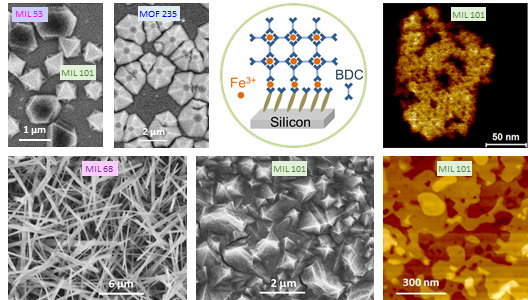
Fig.1 : Growth of Fe-BDC MOF : morphologies and structural phases obtained on functionalized silicon surfaces. SEM images (gray) : oriented 3D crystallites (top) or dense poly-crystalline layers (bottom). AFM images (orange-brown) : 2D nano-crystallites with a hexagonal pore network on the topmost surface (top) and 2D ultra-thin layer with extended (111) single-crystal terraces (bottom).
Postdoc project (funding E4C Interdisciplinary research center, IPP) : Weichu FU (2023-2024) "FeBDC MOF layers for the passivation of silicon anode for Li ion batteries"
Recent thesis :
Weichu Fu (CSC 2023), "FeBDC MOF thin Layers : Application to the passivation of Si anodes for Li-ion Batteries"
https://theses.hal.science/tel-04506460v1/document
Publication :
[Yuan2022] Yuan, H. Y., Fu, W. C., Soulmi, N., Serre, C., Steunou, N., Rosso, M., de Villeneuve, C. H., Growth of Fe-BDC Metal-Organic Frameworks onto Functionalized Si (111) Surfaces, CHEMISTRY-AN ASIAN JOURNAL, 2022, 17, e202200129
https://doi.org/10.1002/asia.202200129